Showing posts with label Shrine. Show all posts

Tuesday, February 16, 2016

Ancient capital Nara


Nara-Park

Nara city is a beautiful and quaint city in the Kansai area,  outstanding by his effort to balance nature with the rapid development of modern Japan. The city simbol are the wild deer that roams freely in the city.

Kasuga shrine

Eight places in the city: Todai-ji, Kofuku-ji, Kasuga shrine, Ganjou ji, Yakushi-ji, Toshodai-ji, Nara palace site, Kasugayama primaveral forest,  has been collectively designated as UNESCO World heritage site.
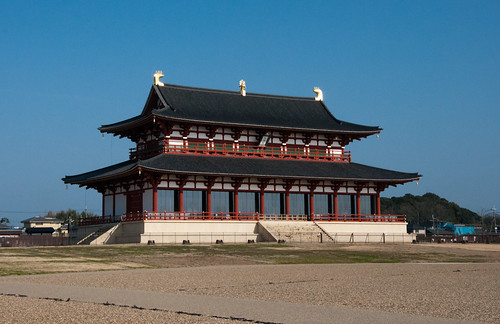
Heijo palace
Toudai-ji, Koufuku-ji and Kasugayama primaveral forest are link togueter by Nara Park. The Park is renowed by the deers roaming through the premises and the surrounding areas. The deers have been designed a natural monument by the Japanese government.

Todai-ji

Daibutsu

Todai ji houses the world's largest bronze Budha and the  daibutsuden hall itself is the largets wooden building in the world.

Kofuku-ji

The city is one hour from Osaka and Kioto so a day trip visits are popular, however, a longer stays is recommended to appreciate fully the city sites..

Wednesday, October 17, 2012

Kasama Inari Shrine


DSC_0102-HDR
The Kasama Inari Shrine in Kasama city, Ibaraki, one of the three largest Inari Okami Shrines in Japan, was founded in 651, and is dedicated to the Ukanomitama no kami, the spirit with jurisdiction over the five grains and foodstuff.

DSC_0106
DSC_0107
The Shrine suffered serious damage during the Tohoku earthquake. An illustration of this is the now absent torii gates, pending restoration at the time of my visit. Similarly the purification font is with a big crack on the roof, apparently caused by the quake, and is yet to be repaired. On the other hand, some of the buildings bear signs of the of the fresh damage reparation.

DSC_0110
The old main gate to the shrine, now known as the east gate, it is now located at the right side of the main approach to the premises. With an edo style high gable roof, now has a recently refurbished roof, built still keeping most of its original condition.

DSC_0105
DSC_0113
DSC_0112
DSC_0116
The new gate, known as Romon, is a two stories gate, built in 1961. Guarded by two guardian deities, at the sides, and a pair of wood horses at the back; attesting the age of the shrine.

 DSC_0114
 DSC_0125
DSC_0121
DSC_0122
After the main gate, the main hall or haiden, dominates the ground premises. Built in 1960, the hall is relatively new but as the main gate case, some of the decorations are quite old.

DSC_0123
Make sure that you visit the main sanctuary at the back of the main hall, constructed in 1856, or you will miss it as I regrettably did.


View Kasama Inari Shrine in a larger map

Saturday, May 26, 2012

Hibiya Shrine in Shinbashi


DSC_0441
The hibiya Shrine in Shibashi is a small shrine surrounded by the Shiodome and Shinbashi buildings. Founded in 1606, it was rebuilt and relocated to current location in 2009.

DSC_0437
DSC_0433
The Shrine surrounded by the Shiodome skyscrapers, present an striking view, with the great contrast of an old style shrine and modern architecture.

DSC_0444
If you visit the shiodome area, this shrine is a must to appreciate the mix of old and new, characteristic of Tokyo.


View Hibiya Jinja in a larger map


Tuesday, July 12, 2011

Mt Tsukuba Shrine

Mt Tsukuba Shrine
Mt Tsukuba Shrine is an ancient shrine in the Ibaraki Prefecture. The shrine has a history of over 3000 years, its name appearing in poems written in the 8th and 10th century. Tsukuba Mountain has been considered a sacred mountain since people started to live in the Kanto area. The male “kami” or spirit, enshrined on the Nantaysan peak, and the female “kami”, enshrined on the Nyotaisan peak, represent the Izanagi-no-Mikoto and Izanami-no-Mikoto deities. Tha main hall of the shrine is at the base of the mountain on the south side.

DSC_0443
DSC_0447
DSC_0451
A huge metal Torii signals the way to the shrine, and a smaller concrete torii marks the entrance to the shrine grounds.

DSC_0456
The holy bridge was dedicated by a Tokugawa warlord to the shrine, and passing through the bridge is allowed only on certain festival days in February, March and November.

Wooden gate
DSC_0462
The gate to the main courtyard is beautiful old wooden gate that gives perfect emphasis to the age of the shrine.

DSC_0472
In the main court there is an old tree called “marubakusu”, it has been designated as a natural monument by the city, it is said that there are only two trees of this type in Japan.

DSC_0473
DSC_0474
The gardens on the courtyard are beautiful and well kept. Some of the structures were slightly damaged by the earthquake and still need to be repaired.

DSC_0485
DSC_0484
DSC_0489
DSC_0494
DSC_0495
The Main shrine with his giant bell. the carving on the shrine and adjacent building, are similar to the ones in Nikko.

DSC_0498
DSC_0497
DSC_0501
The shrine it is believed to bestow marital harmony and conjugal bliss and has become a popular place for traditional Japanese weddings.

View Mt Tsukuba in a larger map


Español

Wednesday, April 27, 2011

Oji Shrine

Ouji Jinja-HDR
Oji Shrine in the Kita ward is one of the most important shrine in Tokyo. Designated as one of the ten main Shrines in Tokyo by the emperor Meiji in 1868. The foundation date is unknown; in 1322, warlord Toyoshima renamed the shrine to its current name Oji Jinja.

DSC_0446
DSC_0406
Oji Shrine is located on top of a small hill, next to the otonashi shinsui park, accessible by climbing a few stone steps or by entrance on route 455. The current building was reconstructed after the second world war.

DSC_0414
DSC_0437
DSC_0422
The Shrine annual festival “dengaku”, celebrated in October, has been designated as an important intangible cultural asset by the Kita ward.

DSC_0417
On the same compound, there is a rare subordinated shrine dedicated to the hair, the shrine has many followers on the Wig industry and with tokoyama or Japanese traditional hairdresser.

View Oji Shrine in a larger map

Español

Sunday, March 6, 2011

Temples at Naritasan

shakado hall
At the Narita san temple complex, the structures testify on the historical opulence and importance of the temple, with the most prominent being the Shinshoji main hall, covered on the previous post. The surrounding structures are of not less importance and stand out on its own by merit of their beauty, and importance.

shakado hall
shakado hall
The Shakado hall (former main hall), standing next to the main hall, is a wooden structure erected in 1858, designated an important cultural property and a truly characteristic structure of the late Edo period.

Gakudo Hall
Gakudo Hall
Gakudo Hall
Gakudo Hall
The Gakudo hall is normally a very small and austere structure, The Naritasan one built in 1861, considering the size and detailed decorations, give evidence on the profound devotion to Buddhism in earlier times. This structure has also been designated an important cultural property.

Komyodo hall
The Kyomodo hall an earlier main hall built in 1701; the features of the structure are representative of the mid-Edo period.

Great Pagoda of Peace
Great Pagoda of Peace, Naritasan
The great Pagoda of peace was erected quite recently, in 1984, in prayer of world peace, with 58m of height the structure is enormous, note the size of the people walking around the structure.

清瀧権現堂
清瀧権現堂
開山堂
開山堂
DSC_0266
DSC_0272
Other structures are the Seiryu Gongen Dou hall built in 1732, the Kaizandou closed to the public, and the Shussei Inari shrine (this shrine is not part of Naritasan, eventhough is in the same location).


View Naritasan in a larger map


Español